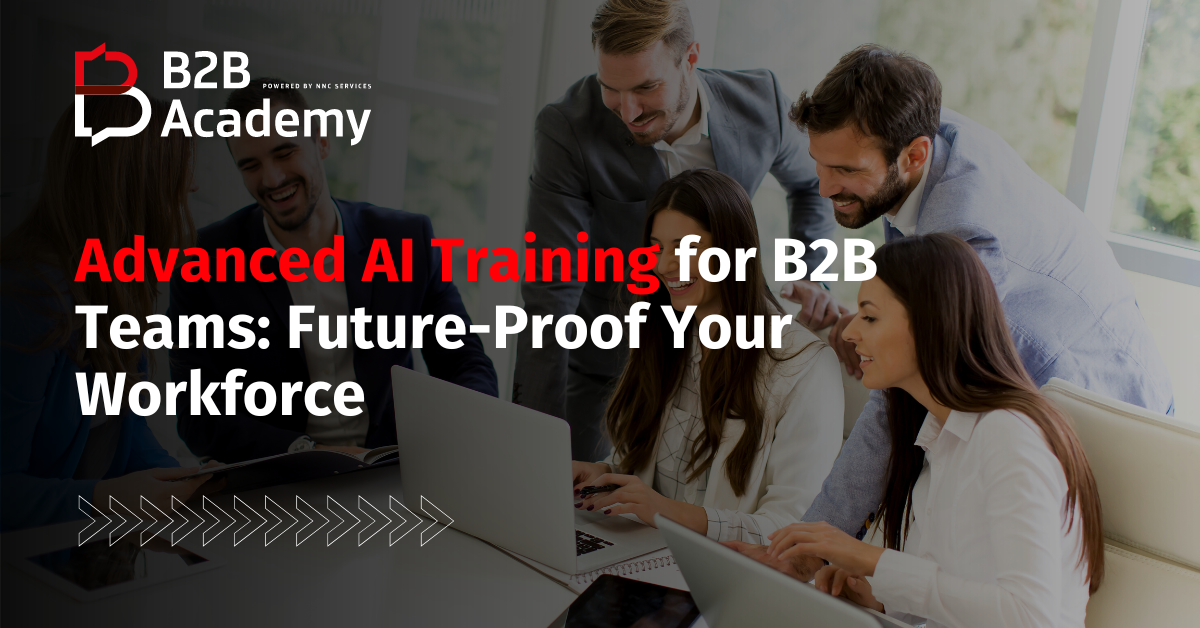
Integrating and proficiently using AI can be the difference between leading the market or trailing behind. To stay competitive and relevant, investing in advanced AI training for your team is necessary. This article will explore how AI can improve productivity and efficiency, with insights for future-proofing the workforce against constant technological advancements.
Is AI Training a Must for B2Bs?
Artificial intelligence has become indispensable for business operations, from automating daily tasks to providing in-depth insights through data analytics. In the B2B sector, AI facilitates improved customer relationship management (CRM), predictive analytics, personalized marketing, and streamlined supply chain operations. As AI technologies advance, the potential applications in B2B are expanding exponentially.
However, AI’s effectiveness relies on the human factor that uses it. In that sense, it becomes essential that your team is properly trained to leverage AI in order to improve processes and drive business growth.
Components of Advanced AI Training
1. Understanding AI Fundamentals and Applications

Before exploring the more complex AI systems, teams must understand the basics. This includes knowledge of machine learning, natural language processing (NLP), computer vision, and neural networks. Training programs should cover these fundamentals and illustrate how they apply to specific B2B processes such as sales forecasting, customer segmentation, and automated customer support.
2. Hands-On Experience with AI Tools
Theoretical knowledge must be supplemented by practical experience. Hence, B2B teams should engage in hands-on training with leading AI tools and platforms like TensorFlow, PyTorch, and IBM Watson. This includes learning to develop and train machine learning models, create and manage data sets, and utilize AI for predictive analytics. Practical workshops and real-world projects can significantly improve the learning experience.
3. Data Literacy and Management
AI thrives on data. Therefore, data literacy is an essential component of AI training. Teams need to be proficient at collecting, cleaning, and managing data. This includes understanding data governance, privacy concerns, and ethical considerations. Advanced training should also cover data visualization tools like Tableau and Power BI to help teams effectively interpret and communicate AI-driven insights.
4. Integration and Implementation Strategies
AI solutions must be integrated seamlessly into existing business processes. Training should encompass strategies for successful AI implementation, including change management, aligning AI initiatives with business goals, and measuring the impact of AI on operations. This ensures that AI-driven projects are not isolated efforts but part of a cohesive strategy that drives overall business growth.
5. Continuous Learning and Adaptation
The AI landscape is dynamic, with new developments and innovations emerging regularly. Therefore, continuous learning should be an integral part of AI training programs. Encouraging a culture of ongoing education, whether through online courses, certifications, workshops, or industry conferences, ensures that teams remain at the cutting edge of AI technology.
Benefits of Advanced AI Training
Better Decision-Making
AI can process vast amounts of data far more quickly and accurately than humans, providing actionable insights to inform strategic decisions. Trained teams can leverage AI to analyze market trends, customer behavior, and operational metrics, leading to more informed and timely decisions.
Improved Efficiency and Productivity
AI automation of routine tasks allows employees to focus on higher-value activities. For example, AI-powered CRM systems can automate customer interactions and follow-ups, while predictive analytics can optimize inventory management. This boosts overall productivity and operational efficiency.
Personalized Customer Engagement
AI enables B2B companies to deliver highly personalized customer experiences. By analyzing customer data, AI can tailor marketing messages and product recommendations and support interactions to individual preferences and behaviors. Trained teams can effectively use these capabilities to improve customer satisfaction and loyalty.
Competitive Advantage
Leveraging AI can be a significant differentiator in terms of competitive advantages. Companies that invest in advanced AI training for their teams are more likely to innovate, adapt to market changes, and offer superior products and services. This approach helps retain existing clients while also attracting new business.
Scalability
AI can help you scale operations efficiently without a proportional increase in costs. For instance, AI-driven chatbots can handle customer inquiries 24/7, and machine learning algorithms can manage large volumes of data without additional human resources. Well-trained teams can manage and scale these technologies effectively.
Implementing Advanced AI Training: Best Practices
Customized Training Programs
B2B companies should develop customized training programs aligned with their industry and business needs. These programs would involve assessing employees’ current skill levels, identifying gaps, and designing training modules that address these gaps. Personalized training ensures that the learning is relevant and immediately applicable.
Collaborative Learning Environment
Encouraging a collaborative learning environment can improve the effectiveness of AI training. Teams should be encouraged to share knowledge, work on projects, and learn from each other’s experiences. This creates a culture of innovation and continuous improvement.
Leveraging External Expertise
Partnering with external experts, such as AI consultants and training providers, can bring valuable insights and advanced knowledge to the training program. External experts can provide specialized training that may not be available in-house and offer a fresh perspective on AI applications.
Measuring Training Effectiveness
It is essential to measure the training program’s effectiveness to ensure that it is delivering the desired outcomes. This can be done through assessments, feedback surveys, and performance metrics. Regular evaluation helps refine the training program and address any gaps.
Supportive Leadership
Leadership plays a crucial role in the successful implementation of AI training programs. Top management support regarding resources, time, and encouragement can significantly impact the training initiative’s success. Leaders should champion AI training and demonstrate its importance to the organization’s future.
Advanced AI training is a strategic investment that B2B companies must pay attention to. By equipping teams with the necessary skills and knowledge, businesses can leverage the full potential of AI, driving innovation, efficiency, and competitive advantage. For more insights into advanced AI training and how you can leverage it to drive business growth, feel free to learn more about our upcoming AI-Driven Marketing Strategies Summer Bootcamp.