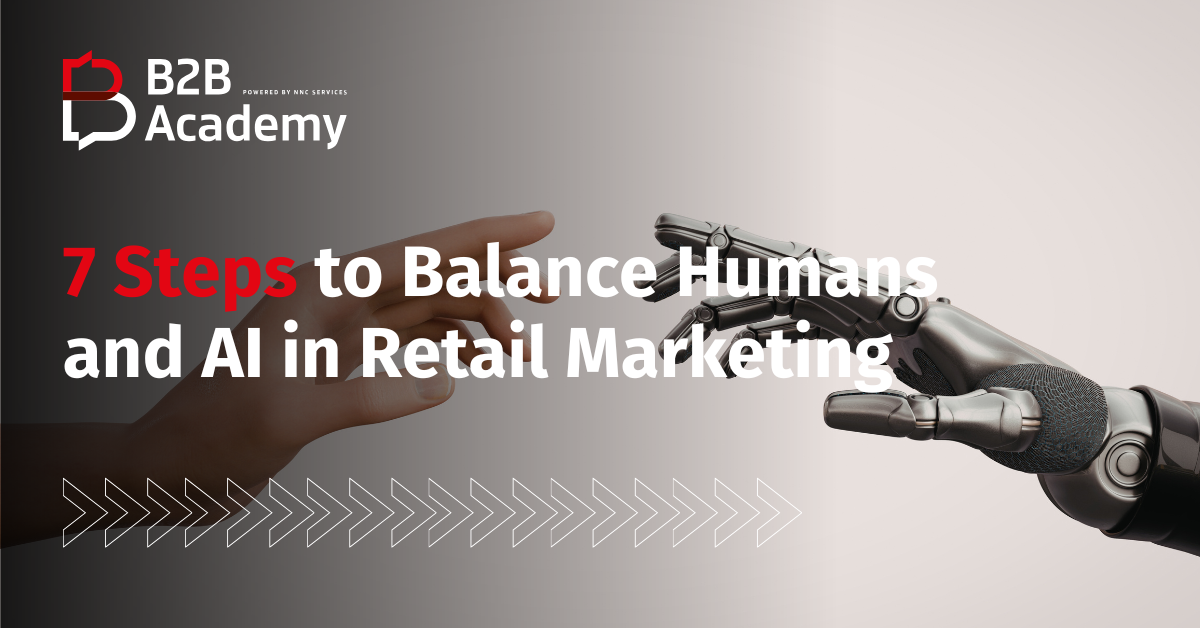
You’ve probably noticed that every few months, a new AI tool claims it’s here to “change the way you work.” It promises smarter decisions, faster campaigns, and better results. And while some of that is true, one question still lingers for every marketing leader: how do you actually build a team where AI and humans work together instead of competing for space?
If you’ve ever tested a shiny new AI tool only to realize your team spent more time fixing its output than using it, you’re not alone. The truth is, the most successful B2B retail marketers in 2025 won’t be the ones who automate everything; they’ll be the ones who know when to rely on machines and where to keep the human touch.
This article explores what that balance looks like, the roles you’ll need on your team, and how to make sure creativity doesn’t get lost in the code.
The new reality of retail marketing
B2B retail marketing has always been a blend of art and analytics. But in 2025, that mix is shifting fast. You’re expected to personalize campaigns, predict buying behavior, and measure ROI across dozens of channels, all while adapting to AI-driven customer expectations.
So, how do you keep up without turning your marketing department into a tech support team?
Let’s start with what’s changing:
- Data complexity is increasing. You’re now managing data from e-commerce, in-store sensors, CRM, and external intent signals.
- Buyer journeys are nonlinear. AI allows for constant micro-interactions, meaning you need systems that recognize patterns humans might miss.
- AI literacy is becoming essential. Every marketer doesn’t need to code, but understanding how models make predictions is now part of the job.
The goal isn’t to automate humans out of the process; it’s to make their work smarter, faster, and more informed.
Step 1: Define what AI does best
Think of AI as a colleague who’s brilliant at analysis but lacks intuition. It’s fast, objective, and never tired, but it doesn’t understand your brand voice or your customer’s emotions.
Here’s where AI truly shines in retail marketing:
- Pattern recognition: spotting buying trends, product correlations, or intent signals across millions of data points.
- Predictive analytics: estimating which accounts are likely to purchase next or churn soon.
- Personalization at scale: tailoring content recommendations or product suggestions in real time.
- Performance reporting: generating dashboards that cut through data clutter and highlight actionable insights.
Ask yourself: Which parts of your current workflow are repetitive, data-heavy, or too time-consuming for people to enjoy? Those are the areas AI can take over, no offense to your spreadsheets.
Step 2: Define what humans do best
AI may be the analytical powerhouse, but you and your team bring the context, creativity, and empathy. Humans handle the gray areas, the things algorithms can’t measure.
Your people should own:
- Strategy development: deciding which insights matter and how to act on them.
- Storytelling: crafting messages that resonate beyond data points.
- Relationship-building: maintaining trust with partners, clients, and customers.
- Ethical oversight: ensuring AI decisions don’t cross ethical or privacy lines.
Put simply, your marketers should think and empathize, while the machines should calculate and predict.
If you’ve ever seen an AI-generated email subject line that made you cringe, you already know why human review still matters.
 Step 3: Build hybrid roles, not silos
In many organizations, AI adoption stalls because it’s treated like a separate project run by “the data team.” That approach doesn’t work anymore.
Instead, the future belongs to hybrid roles marketers who are fluent in both creative thinking and data interpretation.
Some emerging roles to consider:
- Marketing Data Translator: bridges the gap between data scientists and campaign managers, ensuring AI insights are actionable.
- AI Experience Designer: works on how AI interacts with customers (chatbots, recommendations, personalization flows).
- Predictive Content Strategist: uses insights from AI tools to shape content topics, timing, and tone.
- Ethical AI Officer: reviews how customer data is used and whether AI recommendations align with brand standards.
The key is not to replace people but to expand their toolset. You don’t need everyone to be a data scientist, but everyone should understand what AI can do for their role.
Step 4: Train your team like you’d train your model
AI models learn from data; your team learns from context. The better the training, the better the output.
Here are a few practical steps to keep both learning together:
- Host AI skill sessions. Regular 30-minute internal workshops help marketers explore new tools safely.
- Encourage experimentation. Set aside time for team members to test tools without pressure for perfection.
- Promote curiosity over control. Reward people for asking, “What happens if we try this?” instead of fearing mistakes.
- Build an AI playbook. Document best practices for tool usage, prompts, and campaign evaluation so insights don’t vanish when someone leaves.
Think of it like your own “human training dataset.” The more experience your team collects with AI, the smarter both sides become.
Step 5: Keep creativity at the center
With AI handling repetitive work, your team can focus on what machines can’t replicate: creative thinking. But creativity in a retail marketing context doesn’t just mean visuals or slogans. It means connecting data-driven insights to real human needs.
Ask yourself:
- Are your AI-powered recommendations aligned with customer emotions, not just purchase history?
- Does your team have time reserved for brainstorming, or is every hour spent on dashboards?
- When was the last time someone challenged an algorithm’s suggestion because it didn’t feel right?
The best retail marketing teams will use AI as a starting point, not a finish line.
Step 6: Rethink leadership for the AI era
If you lead a team, your role is less about approving campaigns and more about orchestrating collaboration between humans and tools. Leaders who thrive in 2025 will:
- Set vision, not just tasks. Make sure everyone understands why AI is used, not just how.
- Encourage transparency. Ask your team to document how AI recommendations influence decisions.
- Foster trust. Show that AI isn’t replacing anyone, it’s helping everyone make better calls.
- Balance metrics with meaning. AI might tell you engagement rose 20%, but humans must decide whether that engagement matters.
A leader’s job is to connect all the moving parts: the people, the data, and the machines that amplify both.
Step 7: Measure collaboration, not just performance
Traditional metrics like conversion rates or click-throughs don’t tell the full story anymore. In an AI-supported environment, you also need to track how humans and machines work together.
New performance questions might include:
- How often do team members use AI insights to refine campaigns?
- Are we improving decision speed without sacrificing creativity?
- Has the collaboration between marketing and sales become smoother thanks to AI predictions?
Over time, these indicators will reveal if your AI-human partnership is driving genuine progress or just generating more reports.
The perfect retail marketing team for 2025 won’t look like a science lab or an art studio; it’ll look like both. You’ll have data-driven thinkers working next to empathetic storytellers, each supported by technology that extends their abilities rather than replaces them.
AI isn’t here to take your job; it’s here to take your to-do list. The rest, the judgment, creativity, and strategy, still belong to you.
If you want to see how top B2B retailers are already blending AI with human insight, join our upcoming “AI Trends in B2B Retail Marketing” webinar. It’s a practical look at how real teams are making this balance work every day.